
ENHANCING ENVIRONMENTAL COMMUNICATION CAPACITY AND AI APPLICATION AT PU HUONG NATURE RESERVE
- Center for Nature Conservation and Development
- 6 days ago
- 2 min read
As digital transformation continues to advance across various sectors, social media has become an increasingly important channel for environmental communication, helping to raise public awareness of forest protection and biodiversity conservation. Nevertheless, communication activities in many buffer zone communities still primarily depend on conventional approaches such as village meetings, loudspeaker announcements, and poster campaigns. While these methods have contributed positively to information dissemination, their reach and level of public engagement remain relatively limited.
To strengthen local capacity for environmental communication and promote the integration of digital technologies into conservation efforts, Center for Nature Conservation and Development (CCD), in partnership with the Management Board of Pu Huong Nature Reserve (Nghe An province) organized a series of training workshops in May focusing on social media-based environmental education and the application of Artificial Intelligence (AI) in communication activities. The workshops brought together more than 30 forest rangers and reserve staff, alongside over 50 key community representatives from 21 villages located within the buffer zone communes.

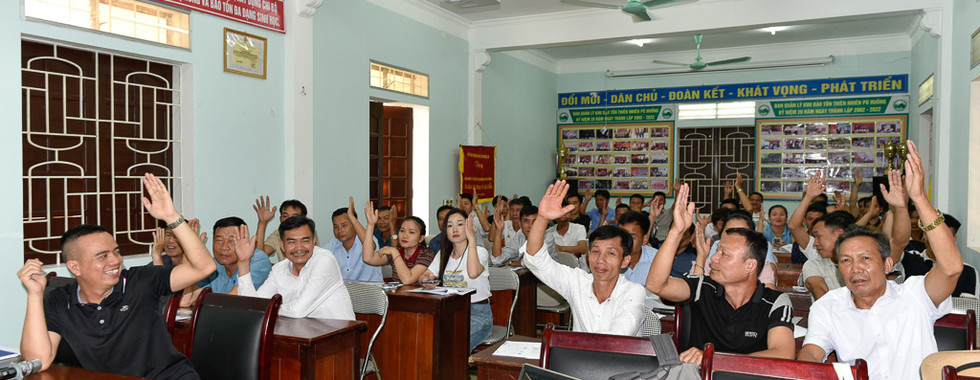



From left to right
Figure 1: Training program for key community representatives
Figure 2: Training program for the Reserve's staff
Figure 3: Introducing commonly used media channels
Throughout the program, participants gained practical knowledge and skills in designing and implementing environmental communication activities through digital platforms. The training also introduced fundamental concepts of Artificial Intelligence and demonstrated how AI tools can support content development, visual design, and information dissemination on social media. In addition to classroom learning, participants engaged in practical exercises to create communication products tailored to local conditions and target audiences.


From left to right
Figure 1: Participants actively engage in the training sessions
Figure 2: Understanding target groups is crucial for creating appropriate communication products.
The training equipped reserve staff and community representatives with innovative approaches and digital tools to strengthen environmental communication and awareness-raising efforts at the community level. The successful implementation of this initiative reflects CCD’s ongoing commitment to working alongside national parks and nature reserves across Vietnam to promote the adoption of digital technologies and Artificial Intelligence (AI) in conservation communication, ultimately supporting more effective and sustainable nature and biodiversity conservation efforts.


Comments